The fluorescent glare of a budget airline gate in London is unforgiving. You stand on the scuffed linoleum, clutching your boarding pass, while the gate agent paces the line like a hawk looking for a field mouse. The metal sizing bin sits near the desk, a rigid cage that has ruined countless vacations before they even started.
Every time a rolling suitcase clanks against the metal bars and refuses to slide down, a credit card is pulled out. The mandatory gate-check penalty hovers over the boarding process, turning a cheap flight into a sudden, expensive ordeal. You watch travelers frantically wearing three sweaters to make their duffels fit.
But you step up to the desk with a soft-sided pack resting quietly against your shoulders. The Osprey Farpoint 40 doesn’t look like a tiny personal item, yet when asked to drop it into the metal frame, it slips down with a satisfying thud. The agent nods, and you walk down the jet bridge.
This is the quiet confidence of knowing exactly how your gear behaves under pressure. You aren’t just crossing your fingers; you are actively utilizing strategic compression strap routing to change the physical footprint of your pack.
The Illusion of Volume
Most travelers look at luggage as a static box. You buy a 40-liter bag, and you assume it permanently occupies forty liters of space. This rigid thinking is exactly what budget carriers bank on. They set their sizer bins a fraction of an inch smaller than standard American carry-ons, trapping flyers in a web of unexpected fees.
The trick is shifting your perspective from rigid frames to adaptable structures. The Farpoint 40 features a harness system that acts more like a corset than a box. By treating the bag as a malleable shape, you turn its slightest perceived flaw into your greatest asset against airline restrictions.
Consider Marcus Thorne, a 38-year-old architectural photographer based in Denver. Marcus shoots concrete brutalism across Eastern Europe, bouncing between tight layovers on Ryanair and Wizz Air. For two years, he paid hundreds in oversized baggage fines, convinced his bulky camera gear and layers required a hard-shell roller.
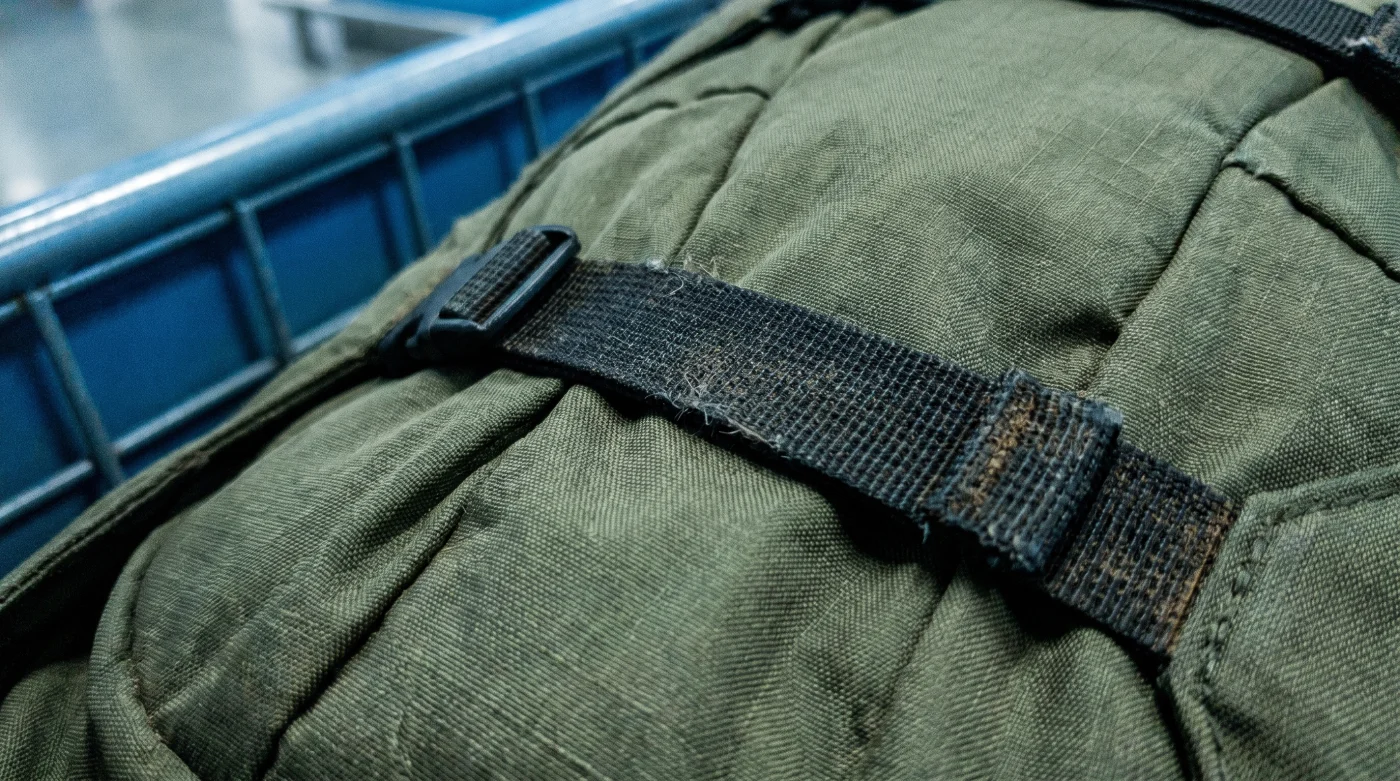
Everything changed when he stopped fighting the sizing bins and started manipulating his pack’s profile. He realized the Farpoint’s external compression straps were designed to bypass the main zipper entirely. By pulling the load directly against the internal frame, he reduced the pack’s depth by three inches, effortlessly clearing strict European sizing limits.
Tailoring the Profile to Your Cargo
Not all packing lists demand the same geometry. How you fill the bag dictates how it compresses. To maintain that fee-free silhouette, your internal organization needs to reflect your external goals.
Let’s look at two distinct approaches to luggage minimalism without sacrifice, ensuring you stay within the confines of those rigid dimensions while keeping what you actually need.
You build your wardrobe around a sparse, modular system: a merino base, a mid-layer, and a protective shell. By wearing the bulkiest pieces onto the plane, the bag is left with just the easily compressible basics. This leaves massive slack in the heavy nylon fabric.
When you cinch down the straps on a half-empty pack, the exterior folds neatly into itself. The bag becomes remarkably flat, easily sliding under the seat in front of you if the overhead bins fill up.
If your trip requires dense hardware like laptops, chargers, or a camera body, the weight distribution shifts. The internal laptop sleeve sits close to the back panel, protecting your electronics from the crush of the cabin.
You must pack softer clothing items toward the front panel. When you pull the external straps tight, the clothes act like a pillow, conforming around the rigid hardware and shrinking the exterior profile down to the absolute minimum depth.
The Straightjacket Technique
Shrinking your pack requires a deliberate routine before you leave the hotel room. It is a physical negotiation between what you want to bring and what the aircraft allows.
You cannot rely on the main zipper to do the work. The zipper is merely a closure; the straps are the true engines of compression.
- Pack the bag flat on a bed, leaving the external compression straps completely loose.
- Distribute the densest items at the bottom near your hips to anchor the bag.
- Zip the main compartment closed, making sure no fabric pinches in the teeth.
- Route the external straps over the load, clipping them securely.
- Place a knee gently in the center of the bag to expel the air.
- Pull the strap tails tight, drawing the outer edges inward.
This creates a firm, cohesive block. The fabric should feel taut, and the outer profile will visibly round off, eliminating the square corners that usually snag on the metal sizing bins.
The Tactical Toolkit: The target dimensions you are aiming for are roughly 21.5 x 14 x 9 inches. Keep a soft tape measure handy during your first few test packs to verify your actual loaded depth.
The Peace of the Unchecked Bag
Walking past the chaotic baggage claim in a foreign airport is a specific kind of relief. You aren’t standing shoulder-to-shoulder with tired strangers, watching a rubber belt slowly spit out battered suitcases.
Bypassing those budget carrier penalties isn’t just about saving forty dollars on a flight. It is about claiming absolute ownership over your time and mobility. You step off the plane and walk straight into town.
You move through the city with everything you need resting comfortably on your back. You can navigate centuries-old cobblestones without rattling wheels, hop onto crowded train cars without apologizing for a massive trunk, and climb narrow hostel stairs with both hands free.
The bag stops being a piece of luggage and becomes an extension of your own movement. By mastering the physical limits of your gear, you remove the friction from the travel experience.
A well-packed bag is just a math problem where the variables are air and fabric; control the air, and the fabric will follow.
| Key Point | Detail | Added Value for the Reader |
|---|---|---|
| Zipper Tension | Zippers only close the fabric; they do not shrink the load. | Prevents blowout and extends the lifespan of your luggage. |
| External Straps | Draw the outer edges inward, reducing depth by inches. | Creates the exact dimensions needed to bypass bin sizing. |
| Weight Placement | Heavy items at the bottom anchor the bag structure. | Makes the pack feel significantly lighter while walking. |
Pack Sizing FAQ
Does the Farpoint 40 count as a personal item?
On rigid carriers like Ryanair, it officially counts as a carry-on, but heavy compression often allows it to pass as a personal item if not fully loaded.What happens if the bag is weighed?
Budget carriers check weight just as often as dimensions. You must keep your gear under 10kg (22lbs) by wearing heavy boots and jackets onto the plane.Can the internal frame bend?
The lightweight wire frame gives the pack its shape but has enough flex to squeeze into a sizer bin without snapping.How do I handle the waist belt during sizing?
Tuck the thick hip belt behind the stowaway back panel before approaching the gate to present a clean, snag-free exterior.Will compression ruin my clothes?
Rolling your garments prevents hard creases, allowing them to absorb the pressure of the straps without coming out wrinkled.