You are standing in the quiet, heavily carpeted corridor of a mid-tier business hotel. The air smells faintly of industrial linen spray and slightly burnt lobby coffee. Your phone screen casts a pale blue glow against your face as the heavy thud of a solid-core door closes behind you.
You did not wait in line. You simply bypassed the sweat-inducing front desk shuffle, opting instead to let a digital key turn the lock on a corner suite you never actually paid for.
Most travelers view the mobile check-in feature as a mere convenience, a way to skip a forced five-minute conversation with a tired clerk. They tap the default assigned room, grab their bags, and accept whatever noisy shoebox overlooks the rooftop HVAC units.
But standard check-in routines miss the hidden algorithmic room inventory logic operating quietly beneath the surface of your screen.
The Architecture of Digital Inventory
Think of a hotel’s property management system as a pressurized water pipe. At the front desk, human agents act as manual valves, putting you wherever there is an immediate empty slot. They are explicitly trained to hold back premium rooms for last-minute, high-paying walk-ins or VIP escalations.
When you rely on a human, you are subject to rigid protocol and human hesitation. The algorithm, however, operates purely on spatial efficiency, seeking only to balance the immediate load of arriving bodies against the mathematical realities of housekeeping schedules.
This brings us to the quiet brilliance of David Miller, a 47-year-old regional logistics director who spends roughly 140 nights a year sleeping in different area codes. David rarely speaks to front desk agents about upgrades. Instead, he plays the system’s own rules against itself. He noticed early on that standard rooms on the highly-requested top floors are the first to be selected by eager guests wanting a view.
By intentionally requesting a room on a mundane, unappealing mid-level floor—say, floor four out of twelve—he forces the software into a mathematical corner. When the hotel inevitably oversells those lower, cheaper floors to block-booking corporate groups, the algorithm automatically bumps early-check-in individuals upward to free up contiguous blocks. David does not ask for the corner suite; the system literally hands it to him out of sheer mathematical necessity.
For the Corporate Sprinter
If you are traveling Tuesday through Thursday, you are competing against an army of road warriors who blindly select the highest floor available. They want the illusion of status and distance from street noise.
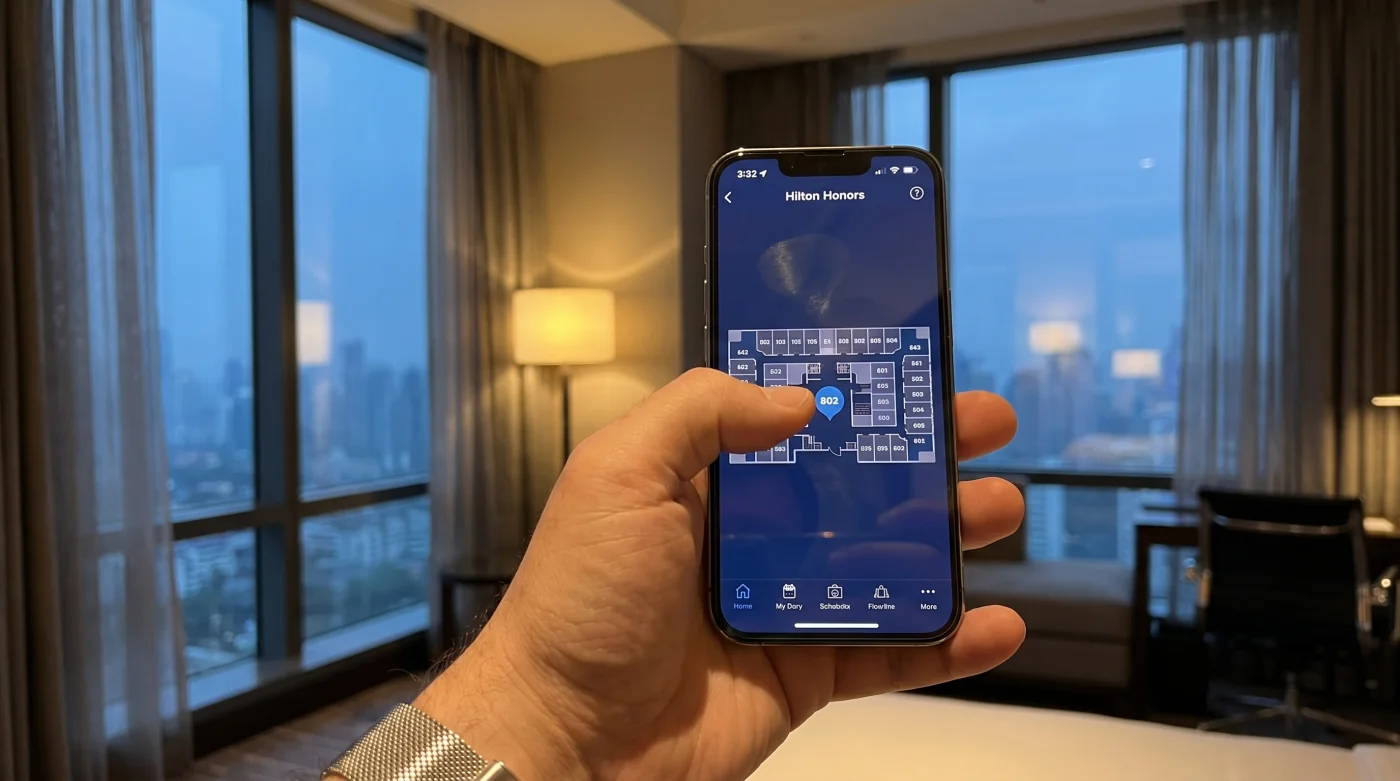
By selecting a room right in the middle of the structural stack, you become an anomaly in the data. The Hilton Honors app reads your mid-floor selection as a low-priority placement, keeping you out of the high-demand upper tiers until the lower floors suddenly max out with late-arriving sales teams. Then, the system silently shoves you into an unbooked corner suite to balance the ledger.
For the Weekend Escapist
Friday and Saturday nights change the rhythm. Leisure travelers arrive in pairs or families, requiring double beds and adjoining rooms. They rarely use the app to select specific rooms, relying instead on desk agents to place them together.
You can use this behavior to create a frictionless upward suite trajectory before you even arrive. Select a single king room on a floor known for double-occupancy layouts. The algorithm will eventually need that specific room to satisfy a family’s adjoining request, immediately kicking your reservation up to the premium tiers where families rarely book.
Executing the Mid-Floor Squeeze
Using this logic requires a mindful, minimalist approach. It is not about gaming the system with aggressive complaints; it is about slipping quietly into the cracks of the hotel’s own digital framework.
You must train yourself to ignore the temptation of the highest floor, acting instead like water finding the path of least resistance.
Here is your tactical toolkit for your next check-in window:
- Wait until exactly 24 hours before your arrival time to open the app.
- Bypass the ‘Recommended Room’ entirely, as this is just the algorithm filling dead space.
- Navigate to the floor plan and locate the middle floors (e.g., floors 4, 5, or 6 in a 10-story building).
- Choose a room near the elevator—these are often flagged as less desirable, increasing your chances of an algorithmic bump.
- Do not select the digital key immediately; wait until you land at your destination to trigger the final room assignment.
This deliberate delay is crucial. It gives the property management software ample time to process the chaotic influx of standard guests, creating the exact inventory pressure needed to force your automatic upgrade.
Reclaiming Your Rest
Learning to manipulate the app is about more than just securing a few extra square feet of living space or a slightly larger television. It is about taking control of an environment that is historically designed to process you as a mere number.
When you understand the underlying mechanics, you eliminate the exhausting performance of begging at the end of a long travel day. You arrive knowing that the system has already worked on your behalf, allowing you to walk straight past the noise, swipe your phone, and finally drop your bags in a room that actually lets you breathe.
The front desk manages feelings; the app manages inventory.
| Key Point | Detail | Added Value for the Reader |
|---|---|---|
| Floor Selection | Target floors 4-6 instead of top levels. | Forces the system to bump you when lower floors oversell. |
| Timing the App | Select room at 24 hours, confirm key upon landing. | Allows the algorithm time to build inventory pressure. |
| Room Proximity | Pick rooms near elevators intentionally. | Increases algorithmic likelihood of being relocated to a premium suite. |
Frequently Asked Questions
Does this work for all Hilton tiers? Yes, but Gold and Diamond members will see the algorithmic bump occur much faster due to baseline status weighting in the software.
What if I actually want a higher floor? If the view is your absolute priority, bypass this method. This tactic is strictly for securing square footage and corner suite layouts.
Will the app notify me of the upgrade? Occasionally it will push a notification, but often you will simply notice your room number has changed when you request the final digital key.
Does this work at resorts? Resort inventory is heavily skewed by multi-night leisure stays, making the algorithm less volatile. This method thrives in business-heavy urban and airport locations.
What if the hotel is mostly empty? If the property is operating below 60% capacity, the mid-floor squeeze will not work, as there is no inventory pressure to trigger the bump.